
Why Does Your Nose Run When You Eat or Experience a Temperature Change
A runny nose is commonly associated with allergies, a cold, or a sinus infection. However, some people develop clear, watery drainage specifically while eating or when moving between warm and cool environments.
These reactions may be forms of nonallergic rhinitis. Instead of responding to pollen, mold, or another allergen, sensitive nerves and blood vessels inside the nose react to triggers such as spicy food, hot meals, cold air, temperature changes, smoke, or strong fragrances.
At Jupiter Sinus and Allergy, the clinical team helps patients in Jupiter and nearby Palm Beach County communities determine whether recurring nasal drainage may be related to allergies, nonallergic rhinitis, or another nasal condition.
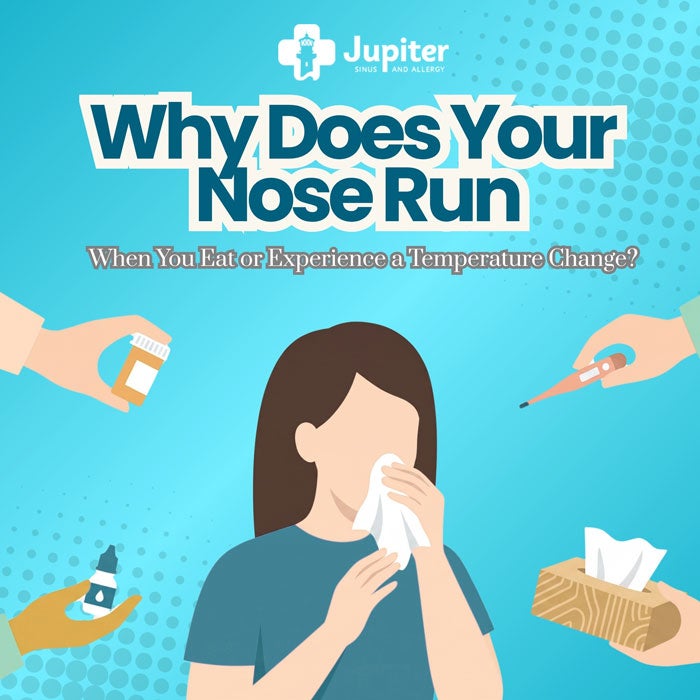
Direct Answer: Why Does Your Nose Run When You Eat or Experience a Temperature Change?
A runny nose that begins during a meal may be caused by gustatory rhinitis, particularly when spicy or hot foods trigger clear, watery drainage.
A runny nose that begins after moving between different temperatures may be associated with nonallergic rhinitis, sometimes called vasomotor rhinitis. Temperature changes can stimulate sensitive nerves and blood vessels inside the nose, increasing mucus production.
Neither reaction necessarily means that you have a cold, sinus infection, or allergy. However, an evaluation may be helpful when symptoms are frequent, disruptive, or accompanied by signs of an allergic reaction.
What Is Gustatory Rhinitis?
Gustatory rhinitis is a form of nonallergic rhinitis that causes nasal drainage during or shortly after eating. It is most commonly associated with spicy or physically hot foods.
“Gustatory” refers to taste. The condition is caused by a nerve reflex rather than an immune-system response to a food allergen.
Symptoms may include:
- Clear, watery nasal drainage
- Postnasal drip
- Sneezing
- Nasal congestion
- Watery eyes
- Coughing caused by drainage into the throat
Symptoms typically begin during the meal and improve shortly after the person stops eating.
Why Do Spicy Foods Make the Nose Run?
Spicy foods frequently contain capsaicin, the chemical responsible for the burning sensation in chili peppers.
Capsaicin and heat can activate the trigeminal nerve, which carries sensory information from the face and nasal passages. That stimulation triggers a reflex that increases mucus production and may widen blood vessels in the nasal lining.
The body reacts as though it needs to flush or cool the area, producing clear nasal drainage.
Foods that may trigger gustatory rhinitis include:
- Chili peppers
- Hot sauce
- Horseradish
- Spicy mustard
- Curry
- Cayenne pepper
- Chili powder
- Ginger
- Onions
- Vinegar
- Hot soups or other heated foods
Triggers vary. One person may react only to very spicy foods, while another may notice drainage with warm soup or nearly every meal.
Is Gustatory Rhinitis a Food Allergy?
No. Gustatory rhinitis is not a food allergy and does not cause anaphylaxis.
With gustatory rhinitis, the main symptom is usually clear nasal drainage during or shortly after eating. It occurs because food stimulates nerves inside the nose—not because the immune system identifies the food as dangerous.
A food allergy may cause symptoms beyond the nose, including:
- Hives or an itchy rash
- Swelling of the lips, tongue, face, or throat
- Wheezing or difficulty breathing
- Abdominal pain
- Vomiting
- Dizziness or fainting
Call 911 or seek emergency medical care for difficulty breathing, throat or tongue swelling, fainting, or other symptoms of a severe allergic reaction.
Why Does the Nose Run During Temperature Changes?
Moving from an air-conditioned building into Florida heat—or from warm outdoor air into a cold indoor environment—can trigger nasal drainage in some people.
This reaction may be associated with nonallergic or vasomotor rhinitis. The nasal lining is controlled partly by the autonomic nervous system, which regulates mucus glands and blood vessels without conscious effort.
A rapid change in temperature or humidity may cause those nerves and blood vessels to react more strongly than expected. The result may be:
- A sudden runny nose
- Nasal congestion
- Sneezing
- Postnasal drip
- A sensation of swelling inside the nose
This does not necessarily indicate an infection. Symptoms may begin quickly after exposure to the trigger and improve once the nose adjusts.
What Is Nonallergic Rhinitis?
Nonallergic rhinitis describes recurring nasal symptoms that are not caused by an allergic immune response or a viral infection.
Possible triggers include:
- Changes in temperature or humidity
- Cold or dry air
- Smoke
- Perfume or cologne
- Cleaning products
- Air pollution
- Exercise
- Spicy food
- Alcohol
- Hormonal changes
- Certain medications
Some people have both allergic and nonallergic rhinitis. For example, pollen may cause an allergic reaction while strong fragrances and temperature changes independently trigger additional symptoms.
How Is Nonallergic Rhinitis Different From Allergic Rhinitis?
The symptoms can overlap, but the pattern may offer useful clues.
Allergic rhinitis is more likely to cause:
- An itchy nose, eyes, or throat
- Repeated sneezing
- Watery or itchy eyes
- Symptoms after exposure to pollen, mold, dust mites, or animals
- Seasonal or environment-specific flare-ups
Nonallergic rhinitis is more likely when:
- Temperature changes trigger symptoms
- Spicy food causes immediate watery drainage
- Smoke or strong odors cause congestion
- Itching is absent
- Allergy medication provides limited relief
- Allergy testing does not identify a relevant trigger
These patterns do not establish a diagnosis by themselves. Allergy testing or an ENT evaluation may be needed when the cause is uncertain.
Could a Sinus Infection Cause the Runny Nose?
A sinus infection may cause nasal drainage, but it usually produces a different symptom pattern.
Sinusitis may be accompanied by:
- Persistent nasal congestion
- Facial pressure or pain
- Reduced sense of smell
- Thick nasal drainage
- Symptoms lasting longer than expected for a cold
- Symptoms that improve and then worsen again
Clear drainage that appears only while eating or immediately after a temperature change is more consistent with a trigger-related reflex than with a sinus infection.
Drainage color alone cannot determine whether an infection is viral or bacterial. Symptom duration, severity, and accompanying findings are more informative.
How Is Gustatory or Nonallergic Rhinitis Diagnosed?
There is no single test that confirms every form of nonallergic rhinitis. Diagnosis generally begins with the pattern of symptoms.
A provider may ask:
- What triggers the drainage?
- Does it occur during every meal or only with certain foods?
- Does cold or warm air bring it on?
- Are itching, hives, or eye symptoms present?
- How long does the drainage last?
- Do allergy medications help?
- Are congestion, facial pressure, or smell changes also present?
The evaluation may include an examination of the nasal passages. Allergy testing may be considered when symptoms could be allergic. Nasal endoscopy or imaging may be appropriate when another structural or sinus condition is suspected.
How Can Trigger-Related Nasal Drainage Be Managed?
Treatment depends on the primary symptom, its triggers, and the patient’s medical history.
Identify and Modify Triggers
Keeping track of meals, environmental exposures, and symptom timing can help identify patterns.
Patients may choose to:
- Reduce the amount of spicy food in a meal
- Allow very hot foods to cool before eating
- Use a scarf or face covering in cold air
- Avoid smoke and strong fragrances
- Make temperature transitions more gradually when practical
- Review possible medication triggers with a healthcare provider
Avoiding every trigger is not always realistic. Treatment may help when symptoms remain disruptive.
Saline Nasal Products
Saline spray or nasal irrigation may help clear irritants and moisturize the nasal passages.
Use distilled, sterile, or previously boiled and cooled water for nasal irrigation. Follow the device’s cleaning instructions to reduce the risk of contamination.
Prescription Nasal Sprays
For prominent watery drainage, a provider may recommend an anticholinergic nasal spray such as ipratropium. Some patients are instructed to use it before known food triggers.
Intranasal antihistamine sprays may help certain forms of nonallergic rhinitis, even though the condition is not caused by an allergy. A corticosteroid nasal spray may be considered when congestion or broader nasal inflammation is also present.
Treatment recommendations vary, and not every spray is appropriate for every patient.
Use Decongestants Carefully
Oral decongestants can affect blood pressure, heart rate, and other medical conditions. Topical decongestant sprays may cause rebound congestion when used longer than directed.
Patients should review product instructions and consult a healthcare provider before using decongestants, particularly if they have high blood pressure, heart disease, glaucoma, or another relevant condition.
Oral antihistamines often provide less benefit for purely nonallergic rhinitis unless allergies are also contributing.
When Should You Schedule an Evaluation?
Consider seeing a healthcare provider if:
- Nasal drainage is frequent or disruptive
- Symptoms occur without a recognizable trigger
- Allergy medication has not helped
- You are unsure whether symptoms are allergic
- Congestion or postnasal drip persists between episodes
- Symptoms affect sleep, meals, work, or daily comfort
- Facial pressure, reduced smell, or recurring sinus symptoms develop
Prompt evaluation is also appropriate for persistent one-sided drainage, bloody discharge, foul-smelling drainage, symptoms following a head injury, or other unusual changes.
Find the Cause of Recurring Nasal Drainage
A nose that runs during meals or temperature changes may be responding to nerve and blood-vessel stimulation rather than an allergen or infection. Gustatory rhinitis and other forms of nonallergic rhinitis can produce frustrating symptoms, but identifying the pattern may help guide appropriate treatment.
Contact Jupiter Sinus and Allergy to schedule an evaluation and determine what may be causing recurring nasal drainage.
Results may vary: Treatment outcomes and health experiences may differ based on individual medical history, condition severity, and response to care.
Emergency Notice: If you are experiencing a medical emergency, call 911 or seek immediate medical attention.
A blocked nose can become especially noticeable during exercise or when you take a deep breath. As your body demands more air, narrowing inside the…

A CT scanner or a small camera used during an ENT exam can look impressive. But for patients, the more important question is what those tools…