
Why Can Nasal Valve Collapse Feel Worse During Exercise or a Deep Breath?
A blocked nose can become especially noticeable during exercise or when you take a deep breath. As your body demands more air, narrowing inside the nose may make breathing feel increasingly difficult.
Allergies, sinus inflammation, and a deviated septum are common causes of nasal obstruction, but they are not the only possibilities. Nasal valve collapse is a structural problem that can restrict airflow, particularly during forceful inhalation.
At Jupiter Sinus and Allergy, we help patients in Jupiter, Florida, identify factors contributing to nasal obstruction and understand which treatment options may be appropriate.
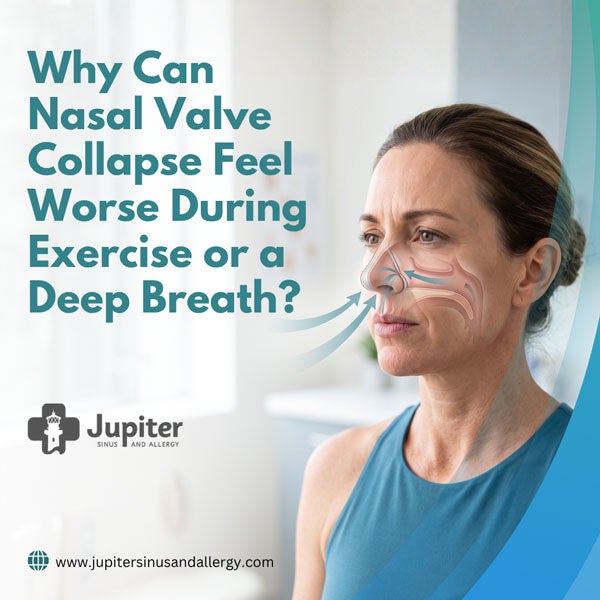
Why Does Nasal Valve Collapse Worsen With Exercise?
During exercise or a deep breath, you inhale more forcefully to increase airflow. That stronger inhalation creates greater negative pressure inside the nose.
If the cartilage or tissue supporting the nasal valve is weak or narrow, the pressure can pull the nasal sidewall inward. This further reduces the airway opening precisely when your body is trying to move more air through it.
This is known as dynamic nasal valve collapse. Common signs include:
- Nasal blockage that becomes worse during exercise
- A nostril or nasal sidewall visibly pulling inward
- Difficulty taking a satisfying breath through the nose
- Improvement when using a nasal strip or dilator
- Switching to mouth breathing during activity
However, exercise-related breathing difficulty should not automatically be attributed to the nose. Asthma and other respiratory or cardiovascular conditions can also cause breathing problems during physical activity.
What Is the Nasal Valve?
The nasal valve is the narrowest part of the nasal airway and contributes significantly to resistance as air moves through the nose.
It has two primary regions:
- External nasal valve: Located near the nostril opening and supported by the nostril rim, surrounding cartilage, nasal floor, and nearby soft tissue.
- Internal nasal valve: Located farther inside the nose, where the nasal septum, upper lateral cartilage, and surrounding tissues form a narrow passage.
The nasal valve is part of the larger nasal airway. While the nose helps filter, warm, and humidify inhaled air, the nasal valve’s shape and stability primarily influence how freely that air can pass through the nose.
What Is Nasal Valve Collapse?
Nasal valve collapse occurs when the nasal valve becomes excessively narrow or lacks enough structural support to remain open during inhalation.
The problem may be present while a person is at rest, or the nasal sidewall may collapse inward only during deeper or faster breathing. Some people experience both patterns.
Because the nasal valve is naturally narrow, even a relatively small structural change can noticeably affect airflow.
What Are the Symptoms of Nasal Valve Collapse?
Symptoms may affect one or both sides of the nose and can include:
- Difficulty breathing through the nose
- Nasal blockage that worsens during exercise
- Persistent congestion that does not respond fully to allergy or sinus medication
- Mouth breathing
- Snoring or difficulty sleeping comfortably
- A nostril or nasal sidewall that pulls inward during inhalation
- Improvement when the cheek is gently moved outward
- Temporary improvement with an external nasal strip or internal dilator
- A visible change in the shape or symmetry of the nose in some cases
These symptoms are not unique to nasal valve collapse. A deviated septum, enlarged turbinates, nasal polyps, allergies, and other conditions can cause similar complaints.
What Is the Difference Between Static and Dynamic Nasal Valve Obstruction?
Nasal valve obstruction can be described as static, dynamic, or a combination of both.
Static nasal valve obstruction
A static obstruction is present even when you are not inhaling forcefully. It may result from a consistently narrow valve area or another structural feature that limits airflow.
People with static obstruction may experience persistent difficulty breathing through the nose during both rest and activity.
Dynamic nasal valve collapse
Dynamic collapse happens when part of the nasal sidewall moves inward during inhalation. It may be subtle during relaxed breathing but become more noticeable during:
- Exercise
- Deep inhalation
- Rapid breathing
- Sleep
- Any activity that increases the demand for airflow
A person can have static narrowing and dynamic collapse at the same time.
What Causes Nasal Valve Collapse?
Nasal valve collapse occurs when the structures supporting the nasal airway are narrow, weakened, or unable to resist the pressure created during inhalation.
Contributing factors may include:
- Natural nasal anatomy
- A deviated septum
- Previous nasal trauma or injury
- Prior nasal surgery, including rhinoplasty
- Loss of tissue strength with aging
- Narrow nostrils or other structural differences
- Weakness or insufficient support in the nasal sidewall
More than one factor may contribute to nasal obstruction. For example, someone may have nasal valve dysfunction along with a deviated septum, enlarged turbinates, or nasal inflammation.
How Common Is Nasal Valve Collapse?
Nasal valve collapse is recognized as a common structural cause of nasal obstruction. However, determining exactly how common it is can be difficult because symptoms overlap with those of other nasal conditions.
A person who continues to feel obstructed after treatment for allergies or inflammation may have an unrecognized structural component. An examination can help distinguish nasal valve dysfunction from other possible causes.
How Is Nasal Valve Collapse Evaluated?
An evaluation generally includes a discussion of when the obstruction occurs, whether one or both sides are affected, and whether symptoms worsen during exercise, sleep, or forceful inhalation.
The provider may also:
- Observe the nose during normal and deep breathing
- Examine the septum, turbinates, and nasal valve
- Perform nasal endoscopy when appropriate
- Ask about previous nasal trauma or surgery
- Use a symptom questionnaire, such as the Nasal Obstruction Symptom Evaluation scale
- Gently support different areas of the nasal sidewall to assess changes in airflow
What Is the Cottle Maneuver?
During the Cottle maneuver, a provider gently pulls the cheek outward to widen the nasal valve area. If breathing feels easier, the result may suggest that widening part of the nasal airway improves airflow.
However, improvement with the Cottle maneuver does not confirm nasal valve collapse by itself. Research has found that many people without nasal valve collapse also report improved breathing during the maneuver. It should be interpreted as one part of a complete examination rather than a stand-alone diagnostic test.
The same caution applies to nasal strips. Feeling better while wearing a strip may provide helpful information, but it does not establish the underlying diagnosis.
How Is Nasal Valve Collapse Treated?
Treatment depends on the location and severity of the obstruction, the structures involved, and how much the symptoms interfere with exercise, sleep, or daily activities.
Options may include:
- External adhesive nasal strips
- Internal nasal dilators
- Treatment of coexisting allergies or nasal inflammation
- Procedures intended to support the nasal sidewall
- Cartilage grafting or other functional nasal surgery
- Septoplasty or turbinate treatment when additional structural problems are present
Breathing strips and nasal dilators may provide temporary support, but they do not permanently change the underlying anatomy. Medication may help if inflammation is also present, but medication alone generally cannot correct a structural collapse.
An ENT evaluation can help determine whether symptoms are primarily structural, inflammatory, or caused by a combination of factors.
When Should You Seek Medical Care?
Consider scheduling an evaluation if:
- Nasal blockage persists despite appropriate allergy or sinus treatment.
- Breathing through your nose interferes with exercise, sleep, or daily activities.
- A nostril or nasal sidewall visibly pulls inward during inhalation.
- You regularly rely on mouth breathing because of nasal blockage.
- Nasal strips or gently supporting the cheek noticeably improves airflow.
- Symptoms began after an injury or nasal surgery.
- One side of the nose remains persistently blocked.
- You experience repeated nosebleeds, facial numbness, or a visible nasal mass.
Seek urgent medical care when breathing difficulty is accompanied by chest pain, fainting, severe wheezing, confusion, or blue or gray lips. These symptoms are not typical of isolated nasal valve collapse and may indicate a more serious medical problem.
Frequently Asked Questions
Why does my nostril collapse when I breathe in deeply?
Forceful inhalation creates negative pressure inside the nose. If the nasal sidewall lacks sufficient support, that pressure can pull it inward and temporarily narrow the airway.
Can nasal valve collapse affect exercise?
It can make nasal breathing feel more difficult during exercise. However, shortness of breath, wheezing, chest tightness, or reduced exercise tolerance may have causes outside the nose and should be evaluated appropriately.
Do nasal strips help nasal valve collapse?
Nasal strips may temporarily lift and support the nasal sidewall, improving airflow for some people. Improvement with a strip does not prove that nasal valve collapse is the only cause of the obstruction.
Can allergy medication fix nasal valve collapse?
Allergy medication may reduce inflammation when allergies are also present, but it cannot directly restore weakened cartilage or correct a structurally narrow nasal valve.
Is the Cottle maneuver an accurate home test?
No. Although improved airflow during the maneuver may suggest that widening the nasal passage helps, it is not specific enough to diagnose nasal valve collapse. A physical examination is still necessary.
Understanding Exercise-Related Nasal Obstruction
Nasal valve collapse can become more noticeable during exercise or deep breathing because forceful inhalation may pull a weakened nasal sidewall inward. Still, nasal valve dysfunction is only one possible cause of difficult nasal breathing.
Jupiter Sinus and Allergy provides ENT, nasal, sinus, and allergy evaluations for patients in Jupiter, Tequesta, Juno Beach, Palm Beach Gardens, and surrounding Florida communities.
If nasal obstruction is affecting exercise, sleep, or everyday comfort, contact Jupiter Sinus and Allergy to schedule an evaluation and discuss which options may be appropriate for your symptoms.
A CT scanner or a small camera used during an ENT exam can look impressive. But for patients, the more important question is what those tools…

Board certification is an important factor that many patients check and consider when choosing an ENT that can provide the care and treatment their…